
The Americans with Disabilities Act (ADA) mandates that public transit systems provide accessible buses with functioning ramps or lifts, designated wheelchair stations, and trained operators. But legal compliance doesn't always translate to seamless service. This guide walks through the specific equipment requirements, securement procedures, boarding protocols, and rider rights established under 49 CFR Parts 27, 37, and 38, and explains when paratransit or Non-Emergency Medical Transportation (NEMT) becomes the better choice.
TLDR: Quick Takeaways
- All fixed-route public buses must have functional ramps or lifts (minimum 600-pound design load) and at least two wheelchair securement stations
- Securement uses a 4-point tie-down anchored to the vehicle floor, plus a separate 3-point lap and shoulder belt for the occupant
- Paratransit must operate within a ¾-mile corridor of fixed routes, match fixed-route hours, and charge no more than double the standard fare
- Operators cannot deny service based on wheelchair design, weight within lift capacity, absence of brakes, or insurance concerns
- When public transit falls short, NEMT providers like AllCare Medical Transport offer 24/7 wheelchair and stretcher transport across Florida
What the ADA Requires for Wheelchair-Accessible Bus Transportation
The Americans with Disabilities Act of 1990 serves as the legal backbone for accessible public transit. All fixed-route buses—city buses, intercity coaches operating scheduled routes—must comply with accessibility standards enforced by the U.S. Department of Transportation through 49 CFR Parts 27, 37, and 38.
Core Equipment Requirements
Under 49 CFR 38.23(b)(1), every bus must have:
- Functional ramps or hydraulic lifts with a minimum design load of 600 pounds
- Platform dimensions of at least 30 inches wide by 48 inches long
- At least two wheelchair securement stations on buses over 22 feet in length
- Priority seating near the front of the vehicle
- Low-floor or ramped entry to minimize boarding barriers
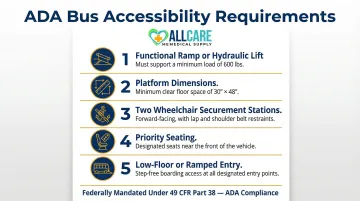
Each of these standards is a federally mandated minimum, not a recommended guideline.
Understanding Lift Weight Limits
Weight limits aren't the only area where agencies fall short—equipment failures are another. Under 49 CFR 37.163, accessibility equipment must remain in working order at all times. Transit agencies must conduct regular maintenance checks and pull buses with broken lifts from service before the next service day.
The regulation allows limited exceptions:
- In areas over 50,000 population: buses with inoperable lifts may stay in service for 3 days if no spare vehicles are available
- In areas under 50,000 population: 5 days maximum
- If the headway to the next accessible bus exceeds 30 minutes, the agency must provide alternative transportation promptly
Outside these narrow windows, stranding a wheelchair user because of a broken lift is a direct ADA violation.
Operator Training Standards
49 CFR 37.173 requires that all transit personnel receive training to proficiency in:
- Operating accessibility equipment safely
- Assisting riders with disabilities respectfully and courteously
- Accommodating different wheelchair types and configurations
However, attendant-style services—manually lifting passengers or providing physical transfer assistance—are not required under federal law.
Types of Bus Services Available to Wheelchair Users
Fixed-Route Public Transit Buses
Fixed-route buses run on set schedules and defined routes, and every one must be fully ADA-compliant. You don't need to call ahead or schedule in advance—simply arrive at any accessible stop and board.
Most buses feature two wheelchair stations positioned under flip-up bench seats near the front. When a wheelchair user boards, other passengers must vacate these seats. There's no advance notice required, no eligibility determination, and no special fare. You ride on the same terms as everyone else.
Paratransit Services
Any transit agency operating fixed-route service must also provide complementary paratransit (a required parallel service) under 49 CFR 37 Subpart F. This door-to-door or curb-to-curb service is specifically for individuals whose disability prevents them from using fixed-route buses.
Key paratransit rules:
- Must operate within a ¾-mile corridor of fixed routes
- Service hours and days must match fixed-route schedules
- Fares cannot exceed twice the standard fixed-route fare
- Requires advance scheduling (typically 24-48 hours)
- Requires eligibility determination through the local transit agency
Riders typically pay reduced fares using pre-purchased tickets. Paratransit is a valuable option, but coverage is bounded by geography and time restrictions—it only operates where and when fixed-route service does.
School Bus Transportation
Under the Individuals with Disabilities Education Act (IDEA), school buses serving students who use wheelchairs must have:
- Wheelchair lifts meeting Federal Motor Vehicle Safety Standards 571.403 and 571.404
- Designated wheelchair securement areas
- Transportation provisions written into the student's Individualized Education Program (IEP) when appropriate
Students using ultralight manual chairs may be assisted to transfer to a standard seat if medically appropriate and approved by the IEP team. School transportation is exempt from general ADA transit rules under 49 CFR 37.27, but must comply with IDEA and FMVSS standards.
Private Buses, Shuttles, and Over-the-Road Coaches
Private transportation entities offering public services are subject to ADA accessibility requirements under 49 CFR 37.33 and 37.37. This includes:
- Airport shuttles and hotel buses
- Charter coaches and tour operators
- Intercity over-the-road carriers
None of these providers can deny service to wheelchair users or claim exemption on the basis of being privately operated.
Wheelchair Securement Requirements on Buses
Federal regulations mandate a two-part securement system to protect wheelchair users in the event of sudden stops or collisions.
The Two-Part System
Under 49 CFR 38.23(d), all ADA-compliant buses and vans must provide:
- Wheelchair tiedown system to anchor the mobility device to the vehicle floor
- Occupant restraint system consisting of a lap belt and shoulder harness for the wheelchair user
Both elements must be present and used together — neither replaces the other.
The 4-Point Tie-Down System (WTORS)
The Wheelchair Tiedown and Occupant Restraint System (WTORS) uses four crash-tested straps—one at each corner of the wheelchair—anchored to the vehicle floor. These systems must meet ANSI/RESNA WC-4:2017 standards, built to withstand a 30 mph, 20 g frontal impact.
Critical attachment rules:
- Straps must attach to the wheelchair frame, never to wheels or removable parts
- Straps must never criss-cross or twist
- Each strap anchors to a separate floor-mounted securement point
- The system must accommodate wheelchairs up to 48 inches long and 30 inches wide
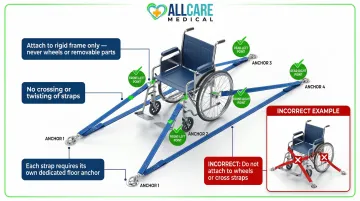
Securement devices must attach to the wheelchair frame, per U.S. Access Board guidance, because wheels and removable components cannot withstand crash forces.
The 3-Point Lap and Shoulder Belt
The occupant restraint belt is separate from wheelchair positioning belts. It must:
- Contact the shoulder, breastbone, and pelvis
- Be crash-tested for transit use
- Be used in addition to—never instead of—wheelchair tiedown straps
Pelvic positioning belts are not crash-tested for vehicle safety and do not substitute for proper occupant restraints.
Operator Securement Policies
Transit agencies may adopt one of two policies:
- Mandatory securement policy: Riders who refuse securement may be denied service. Under 49 CFR 37.165(d), however, operators cannot refuse boarding simply because a wheelchair is difficult to secure — they must use "best efforts" to accommodate any mobility device.
- Optional securement policy: Riders may request securement but cannot be required to accept it.
The Seat Belt Mandate Question
Transit operators may only require wheelchair users to wear lap and shoulder belts if all passengers on the vehicle must do the same. Under 49 CFR 37.5, safety requirements cannot be imposed selectively on riders with disabilities. If ambulatory passengers aren't required to buckle up, wheelchair users cannot be forced to either.
How to Board a Bus in a Wheelchair: Step-by-Step
At the Bus Stop
- Arrive at a designated accessible stop — not all stops have proper boarding areas or curb cuts
- Signal the driver clearly so the driver can prepare the ramp or lift before you approach
- Wait for the driver to deploy the ramp or lift. Operators must provide adequate boarding time under 49 CFR 37.167(i)
Important: Under 49 CFR 38.23(b)(11), you may face either inboard or outboard on the lift. If an operator requires you to face a specific direction, that lift does not comply with ADA regulations.
Once on Board
- Move to the wheelchair securement station, typically located near the front under a flip-up bench seat
- The operator secures 4-point tie-down straps, one at each corner of the wheelchair frame
- You're offered a lap and shoulder belt. Accept or decline based on preference, unless the agency enforces mandatory securement
- Ask for help if needed. On fixed-route buses, operators are required to assist with strap placement upon request
Knowing what to expect on board is half the battle. A little preparation beforehand makes the whole trip smoother.
Practical Preparation Tips
- Research your transit system's accessibility features in advance
- Carry disability ID if your local system provides it
- Know your right to request extra boarding time
- Confirm the route has accessible stops along the entire path
- For power chairs or non-standard frames, tell the operator your securement needs before boarding
Your Rights (and Responsibilities) as a Wheelchair User on Buses
Knowing where the rules fall — and who they apply to — makes every trip smoother. Here's a clear breakdown of what transit personnel are prohibited from doing, what they're required to do, and what riders are expected to bring to the table.
What Operators Cannot Do
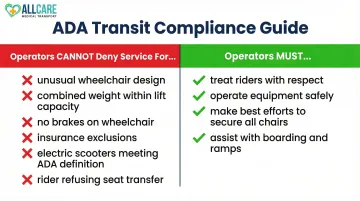
Transit personnel cannot deny service because:
- Your wheelchair is an unusual design or brand
- Your wheelchair and body weight combined exceed 600 pounds (if within the lift's actual design load)
- Your wheelchair lacks brakes—the ADA definition does not require brakes
- Their insurance company conditions coverage on excluding wheelchair users
- Your device is an electric scooter (scooters meeting the ADA wheelchair definition must be accommodated)
- You choose not to transfer from your wheelchair to a vehicle seat—transfers are always optional
Operator Responsibilities
Personnel must:
- Treat all riders with respect and sensitivity
- Operate equipment safely and correctly
- Make best efforts to secure every wheelchair, including unusual or non-standard configurations
- Provide boarding and disembarking assistance, including pushing wheelchairs up steep ramps
Those protections come with a parallel set of expectations on the rider's side. If a mandatory securement policy exists, you must:
Rider Responsibilities
- Allow your wheelchair to be secured or risk being denied service
- Tell the operator which securement approach works best for your wheelchair
- Provide reasonable assistance in positioning your wheelchair within the securement area
When Standard Bus Transportation Doesn't Meet Your Needs
Fixed-route buses and paratransit work well for many wheelchair users, but not everyone. Certain medical and logistical situations fall outside what public transit can handle:
When standard transit falls short:
- Complex medical needs requiring nurse or EMT-level monitoring
- Need for door-through-door assistance (not just curb-to-curb)
- Long-distance medical travel beyond local service areas
- Post-hospital discharge requiring specialized positioning
- Stretcher transport for riders unable to sit upright
- Specialized positioning equipment that standard bus securement cannot accommodate
Non-Emergency Medical Transportation (NEMT) as an Alternative
NEMT providers serve as a bridge when public transit can't meet a patient's actual needs. Unlike fixed-route or paratransit services, NEMT is designed specifically for medically necessary, non-emergency trips.
AllCare Medical Transport, based in Palm Coast, Florida, offers PASS-certified wheelchair and stretcher transport staffed by CPR and First Aid-certified personnel. Available 24/7, they serve Palm Coast, St. Augustine, Daytona, and surrounding Florida counties with door-to-door service for dialysis appointments, hospital discharges, rehabilitation sessions, and similar trips.
If your needs exceed what public transit provides, NEMT is worth exploring — particularly for complex positioning requirements, long-distance medical travel, or situations where a trained attendant needs to remain with you throughout the trip.
Frequently Asked Questions
How to get on a bus in a wheelchair?
Signal the driver at an accessible stop, wait for the ramp or lift to deploy, and board facing either inboard or outboard (your choice). Once on board, move to a designated wheelchair securement station where the operator will apply 4-point straps to anchor your chair and offer a lap and shoulder belt.
What disabilities qualify for paratransit?
Paratransit is available to individuals whose physical, sensory, or cognitive disability prevents them from independently using fixed-route buses. Eligibility requires an application through your local transit agency, which determines whether your disability makes fixed-route travel impossible or unsafe.
How do residents riding in wheelchairs need to be safely restrained in the bus?
A 4-point tie-down system anchors the wheelchair to the floor at all four corners using crash-tested straps attached to the wheelchair frame. A separate 3-point lap and shoulder belt is worn by the occupant. Pelvic positioning belts are not substitutes for proper crash-tested securement.
Can a bus driver refuse to transport a wheelchair user?
Operators generally cannot deny service based on wheelchair type, weight within lift capacity, or absence of brakes. Denial is only permissible if the wheelchair physically cannot fit on the lift or in the securement area, or would block emergency egress routes.
Does a wheelchair need brakes to use public bus transportation?
No. The ADA definition of a wheelchair does not require brakes, and operators cannot deny transportation because a device lacks brakes or because the user chooses not to set them. This is explicitly confirmed in FTA guidance.
What is the difference between paratransit and fixed-route bus service for wheelchair users?
Fixed-route buses run on set schedules accessible to all riders without advance notice or eligibility screening. Paratransit is a scheduled, door-to-door or curb-to-curb service for individuals who cannot use fixed-route transit due to their disability. It requires advance booking, eligibility determination, and operates within the same service area and hours as nearby fixed-route routes.