Introduction
When Maria R.'s father missed three consecutive oncology follow-ups during the height of COVID-19 lockdowns, she didn't think much of it at first. Like many Florida seniors, her 78-year-old father stayed home, convinced that skipping a few appointments was safer than risking infection. But when restrictions finally lifted and he attempted to resume care, the damage was done—his cancer had progressed, and he now needed twice-weekly treatments at a specialist center 40 miles away. Without a valid driver's license and Maria living two states away, he was stranded.
This scenario has played out in countless households across the United States. Non-Emergency Medical Transportation (NEMT) — scheduled, professional transport for patients who need medical care but aren't facing an emergency — has become a critical lifeline for seniors navigating a post-pandemic healthcare landscape.
Unlike ambulances responding to crises, NEMT serves patients traveling to routine appointments, dialysis sessions, physical therapy, and follow-up care.
COVID-19 created a massive backlog of deferred medical needs that continues to drive demand for transportation services today. With 41% of U.S. adults delaying or avoiding medical care during the pandemic — and nearly one-third of older adults reporting postponed treatment — the surge in catch-up care has strained an already fragile transportation infrastructure for America's aging population.
TLDR
- The U.S. NEMT market will reach $18.93 billion by 2031, driven by the aging population and pandemic care backlogs
- 3.6 million Americans miss medical appointments annually due to transportation barriers, costing the healthcare system over $150 billion per year
- 93% of adults 65+ live with at least one chronic condition, making reliable medical transportation a routine necessity—not an occasional convenience
- Before booking, confirm the provider holds state licensing, CPR/First Aid certification, and passes driver background checks
The Post-Pandemic Surge: How COVID-19 Reshaped Senior Transportation Needs
The pandemic exposed a harsh truth: when healthcare access falters, seniors pay the steepest price. The "care deferral effect" created by lockdowns and infection fears led millions of older adults to skip routine medical appointments. By June 2020, 41% of U.S. adults had delayed care, and 32.8% of seniors specifically postponed critical treatments. What started as a temporary pause became a compounding health crisis—deferred screenings, missed medication adjustments, and unmanaged chronic conditions now require more intensive, frequent medical intervention.
These care gaps didn't emerge in a vacuum—transportation vulnerabilities were already there. Public transit ridership plummeted to just 19% of pre-pandemic levels in April 2020, and while it recovered to 77% by late 2023, the gap left many seniors without reliable options. Facility shutdowns, reduced bus schedules, and caregiver unavailability disrupted established transport routines.
Telehealth—initially celebrated as a solution—proved insufficient for seniors requiring hands-on care like dialysis, physical therapy, or oncology infusions.
The Post-Pandemic Rebound
As in-person care resumed, NEMT providers saw dramatic increases in trip volumes. Modivcare, a major NEMT broker, reported 36.8 million paid trips in 2024—a 6.5% jump from 2023. Seniors now represent the fastest-growing NEMT user segment. Catch-up appointments for chronic disease management, cancer follow-ups, and post-hospitalization care are all driving that growth.
Compounding this demand is a broader shift in where seniors choose to live. A 2018 AARP survey found that 76% of Americans 50+ prefer to remain in their homes rather than move to assisted living—a preference that strengthened during COVID-19 as families avoided congregate settings. For seniors aging in place, NEMT becomes essential. They still need reliable transportation to reach:
- Specialist appointments and outpatient procedures
- Ongoing dialysis, infusion, or therapy sessions
- Post-hospitalization follow-up care
The Senior Transportation Crisis in Numbers
The numbers behind America's senior transportation gap tell a clear story:
Market Growth Driven by Seniors:
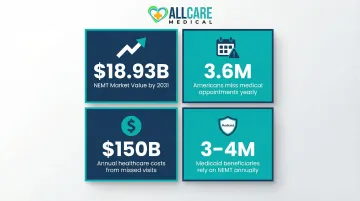
- The U.S. NEMT market is projected to reach $18.93 billion by 2031, growing at an 8.23% annual rate
- Medicaid alone accounts for 51.72% of NEMT spending, underscoring how essential these services are for low-income seniors
Aging Population Growth:
- The U.S. population 65+ reached 61.2 million in 2024 (18% of Americans)
- By 2030, 73.1 million Americans will be 65 or older—that's one in five residents
- Florida's senior population already sits at 21.8%, with Flagler County reaching 31.8%—nearly one in three residents
The Cost of Transportation Barriers:
- 3.6 million Americans miss medical appointments annually solely because they lack reliable transportation
- These missed visits contribute to a $150 billion annual cost to the U.S. healthcare system through preventable hospital readmissions, emergency interventions, and worsening chronic conditions
Medicaid's Role:
- Federal law (42 CFR 431.53) requires all state Medicaid programs to cover NEMT, ensuring low-income seniors can reach covered medical services
- Between 2018 and 2021, 4-5% of Medicaid beneficiaries (roughly 3-4 million people) used NEMT annually, representing a critical safety net for seniors with no other transport options
Key Long-Term Drivers Behind Growing Senior NEMT Demand
Senior NEMT demand isn't a post-pandemic blip. Several structural shifts are locking in sustained growth for years ahead.
The Silver Tsunami
Approximately 10,000 Americans turn 65 every day, a trend that continues through 2030 as the last Baby Boomers reach retirement age. That's a steady, compounding expansion of the population most likely to need medical transport.
While 81% of adults 65+ hold driver's licenses today, vision decline, slower reaction times, medication side effects, and cognitive changes gradually push them off the road. Each year, more seniors cross that threshold.
Rising Chronic Disease Burden
93% of adults 65+ live with at least one chronic condition, and 78.8% manage multiple conditions simultaneously. Among those 85+, 37.3% report four or more chronic diseases.
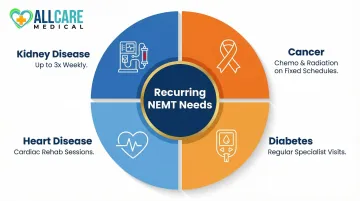
Many of these conditions require frequent, recurring appointments:
- Kidney disease — dialysis up to three times per week
- Cancer — chemotherapy and radiation on fixed schedules
- Heart disease — ongoing cardiac rehabilitation sessions
- Diabetes — regular endocrinology and specialist visits
These aren't occasional trips. They're predictable, repeating transportation needs—exactly what NEMT is built for.
Loss of Driving Ability
Beyond the gradual changes mentioned above, 14% of Americans 65+ have distance vision impairment or contrast sensitivity issues severe enough to make driving cessation likely. The downstream effects go well beyond mobility: losing driving privileges nearly doubles the risk of depression and makes former drivers five times more likely to enter long-term care facilities.
Family caregivers can't reliably fill this gap. Work schedules, distance, and caregiver fatigue all limit how much support families can realistically provide.
Healthcare System Shift to Outpatient Care
Hospitals are discharging patients sooner and delivering more care in outpatient settings to control costs. This trend shifts the transportation burden from inpatient facilities to individual patients and their families. Post-surgical patients, rehabilitation clients, and hospice recipients now require frequent trips between home and care sites—directly expanding NEMT demand for patients unable to drive themselves.
What Quality Senior NEMT Looks Like: A Guide for Families
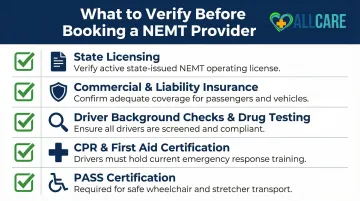
Not all NEMT providers offer the same level of service or safety. Families evaluating transportation options for elderly parents should verify these essential credentials:
Core Credentials:
- State licensing for non-emergency medical transportation
- Commercial and general liability insurance (request proof of current coverage)
- Background checks and drug testing for all drivers
- CPR and First Aid certification for staff
- Specialized certifications like PASS (wheelchair and stretcher handling)
For example, AllCare Medical Transport—a family-owned provider serving Palm Coast and Flagler County since 2010—holds full Florida licensing, maintains commercial and general liability coverage, and requires every employee to pass national and local background checks, drug tests, DOT physicals, and CPR/First Aid certification. Their staff also holds PASS certification for safe wheelchair and stretcher transport. Their staff also holds PASS certification for safe wheelchair and stretcher transport. Credentials like these are the baseline — but availability is equally non-negotiable.
Why 24/7 Availability Matters
Medical needs don't follow business hours. Hospital discharges, sudden appointment changes, after-hours dialysis, and care transitions can happen at any time. A quality NEMT provider offers 24/7 availability with fast response times — not 9-to-5 scheduling with an answering machine after hours.
The Intangibles That Distinguish Great Senior NEMT
Beyond credentials, look for these qualities:
- Staff who treat seniors with patience and respect — never rushing or talking down to them
- Regular updates to family members on pickup status, arrival times, and any delays
- Consistent punctuality that respects tight appointment windows
- Vehicles properly equipped for wheelchairs, walkers, and stretchers
For seniors who are anxious, frail, or cognitively impaired, these qualities directly affect both safety and experience. Ask providers directly how they handle these situations — the specificity of their answer tells you a lot.
Senior NEMT in Florida: Meeting Local Needs in Palm Coast and Beyond
Florida consistently ranks among the states with the highest proportion of senior residents, and communities like Palm Coast, Flagler County, and the greater Daytona corridor are home to large retiree populations who depend on reliable NEMT to access regional medical centers and specialists.
In Flagler County specifically, the demographics make this need concrete:
- 31.8% of residents are 65 or older—nearly one in three
- Public transit runs only 6 a.m. to 6 p.m. on weekdays, leaving gaps for early appointments and evening discharge trips
- 41% of households fall below the ALICE survival budget, making private transportation cost-prohibitive for many
Many of these seniors rely on local NEMT providers to reach healthcare facilities in Daytona, St. Augustine, and Jacksonville for specialized care unavailable closer to home.
AllCare Medical Transport has served this community for over 16 years, providing 24/7 local and long-distance transport across Flagler and Alachua Counties. Owners Lisa and Tim Hogan founded the company in 2010 after Lisa spent years caregiving for her grandmother and father and recognized how much families needed a provider they could genuinely trust. They built the company on a simple commitment: treat every client's family like their own. That means ambulatory, wheelchair, and stretcher transport delivered with the kind of care that goes beyond just showing up on time.
Frequently Asked Questions
What is non-emergency medical transportation (NEMT) and how is it different from an ambulance?
NEMT serves patients who need transportation to scheduled medical appointments but are not experiencing a life-threatening emergency. Ambulances respond to urgent or critical medical crises requiring immediate intervention. The key difference is urgency—NEMT is planned, routine transport; ambulances handle emergencies.
Does Medicare or Medicaid cover senior NEMT services?
Medicaid mandates NEMT coverage as a benefit in all states under federal law. Medicare Advantage plans may include transportation benefits as supplemental services. Traditional Medicare (Parts A and B) generally does not cover routine NEMT unless the patient is bed-confined and other transportation methods are medically contraindicated.
Why has demand for senior NEMT increased since the pandemic?
COVID-19 created a massive backlog of deferred senior care. As older adults return to in-person appointments, catch-up demand—combined with aging-in-place trends and reduced caregiver availability—has sharply increased the need for professional transport to manage chronic conditions and long-postponed treatments.
What should I look for when choosing a NEMT provider for an elderly parent?
Key things to verify before booking:
- State licensing and commercial/general liability insurance
- Staff certifications (CPR, First Aid, wheelchair and stretcher handling)
- Background-checked, drug-tested drivers
- 24/7 availability and experience with mobility or cognitive challenges
How do I schedule non-emergency medical transportation for a senior in Florida?
Contact a licensed local NEMT provider directly by phone with appointment details. Most reputable providers offer advance scheduling for routine trips and flexible booking for recurring appointments like dialysis or chemotherapy. For example, AllCare Medical Transport can be reached at 386-864-7145 and offers online reservation options at allcaremedicaltransport.com.
Can NEMT handle long-distance medical trips or out-of-state transport for seniors?
Yes. Many NEMT providers, including those in Florida, offer long-distance transport across state lines for hospital transfers, specialist visits, or relocation to care facilities. Confirm long-haul capability and vehicle comfort accommodations (reclining seats, climate control, restroom breaks) when booking extended trips.