Introduction
Every day, 3.6 million Americans miss or delay medical care due to transportation barriers. For the 2.7 million wheelchair users nationwide and the 57.8 million Americans aged 65 and older, accessible transportation directly determines access to healthcare, independence, and daily life.
Buying a wheelchair-accessible vehicle (WAV) means navigating a complex landscape of conversion options, ADA compliance standards, and budgets that can stretch from $60,000 to well over $100,000. Families and caregivers face real decisions: side-entry or rear-entry? Power ramp or platform lift? Minivan or full-size van?
This guide evaluates the top five wheelchair-accessible vehicles in 2026 — covering accessibility features, safety ratings, conversion quality, and when professional non-emergency medical transportation (NEMT) is the more practical choice.
TLDR
- WAVs come in three main types: minivans (best for families), full-size vans (ideal for commercial transport), and SUVs (compact and versatile)
- Top 2026 models: Chrysler Pacifica, Toyota Sienna Hybrid, Ford Transit, Ram ProMaster, Chevrolet Traverse
- Choosing the right WAV depends on entry configuration, ramp or lift type, interior clearance, ADA compliance, and securement systems
- Medicare won't cover a vehicle purchase, though Medicare Advantage and Medicaid may cover NEMT ride costs
- Professional NEMT services remove the need for vehicle ownership — no upfront cost, no maintenance
What to Look for in a Wheelchair-Accessible Vehicle
ADA Compliance Baseline
Federal ADA standards under 49 CFR Part 38 set minimum safety and accessibility requirements. Vehicle lifts must support at least 600 pounds, while current conversions commonly offer 1,000-pound capacity. Ramp slopes cannot exceed 1:4 when deployed to ground level, with stricter 1:6 ratios required for vehicles with floor heights between 3 and 6 inches above a 6-inch curb. Doorway openings in multi-car trains must provide at least 32 inches of clear width.
Knowing these baselines helps you verify whether a vehicle — or a transport provider's fleet — actually meets the mark before you commit.
Three Critical Selection Factors
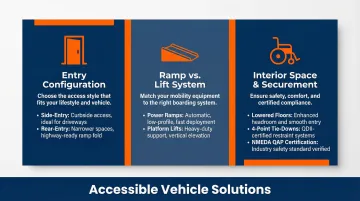
1. Entry Configuration
- Side-entry ramps deploy from the sliding door — the right choice for drivers or front-seat passengers, though they need wider parking spaces
- Rear-entry ramps deploy from the back, cost less, and work well in tight lots; better suited for second-row passengers
2. Ramp vs. Lift System
- Power ramps (hydraulic or electric) deploy with minimal effort — good for independent users and lower ongoing maintenance
- Platform lifts handle heavier power chairs and full-size vans, though they run on battery power and need routine upkeep
3. Interior Space & Securement
- Lowered floors and raised roofs create headroom and turning radius
- 4-point tie-down systems secure wheelchairs during transit
- NMEDA QAP certification ensures compliance with Federal Motor Vehicle Safety Standards (FMVSS)
Long-Term Considerations
Beyond initial features, weigh:
- Fuel efficiency matters for frequent trips — hybrid models can save thousands annually
- Easy-clean interiors are worth prioritizing for medical transport or infection control
- Total maintenance costs over the vehicle's lifespan often outweigh the sticker price difference between models
Top 5 Wheelchair-Accessible Vehicles in 2026
These vehicles were selected based on ADA compliance, conversion quality (primarily BraunAbility and Driverge), safety ratings, and proven performance in personal and commercial use. The list covers different use cases — personal family transport, fuel efficiency, and commercial fleet operation — so use the "Best For" rows in each table to find your match quickly.
Chrysler Pacifica
The Chrysler Pacifica is the benchmark wheelchair-accessible minivan for 2026. With BraunAbility and Driverge conversions widely available, it leads the market in personal-use WAVs.
What makes it stand out:
- Industry-leading interior headroom and doorway clearance
- Multiple conversion options: Power In-Floor (33.5" door width) and Foldout (32.375" door width)
- 1,000 lb ramp capacity with illuminated cabin and ramp
- Flexible seating for up to 7 passengers including the wheelchair user
- Five-star NHTSA safety rating (2025 model)
| Feature | Details |
|---|---|
| Starting MSRP (Converted) | $64,381 |
| Entry Configuration | Side-entry (power in-floor or foldout ramp); rear-entry available |
| Best For | Families, daily personal use, wheelchair users who want to drive or ride up front |
For families who need the Pacifica's versatility but also log significant highway miles, the Sienna Hybrid offers a compelling alternative.
Toyota Sienna Hybrid
The Toyota Sienna Hybrid is the top pick for fuel-efficient wheelchair transport. Its all-hybrid powertrain delivers approximately 36 MPG combined — the best fuel economy of any WAV minivan on this list.
Key differentiators:
- Estimated 36 MPG hybrid fuel economy (EPA)
- Widest ramp in its class per BraunAbility (30.3" usable width)
- Re-engineered center console for better wheelchair maneuverability
- Seating for up to 7
- AWD availability (note: BraunAbility does not currently convert the AWD model)
| Feature | Details |
|---|---|
| Starting MSRP (Converted) | $88,290 |
| Fuel Economy | Approximately 36 MPG combined (hybrid) |
| Best For | Eco-conscious buyers, frequent long-distance users, families needing efficient daily transport |
Ford Transit
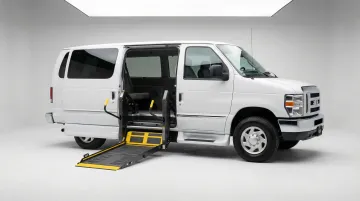
The Ford Transit is the leading full-size van for high-capacity or commercial wheelchair transport. Available in multiple roof heights and lengths, it's the preferred platform for NEMT fleets, paratransit services, and operators moving multiple passengers per run.
Standout qualities:
- Multiple configurations: low, medium, and high roof; regular and extended length
- AWD option and available Ford E-Transit electric model
- Heavy-duty ramp and lift systems (up to 1,000 lb capacity)
- Capacity to accommodate ambulatory passengers, wheelchair users, and stretcher patients simultaneously
- 3.5L EcoBoost V6 engine for power and towing
| Feature | Details |
|---|---|
| Starting MSRP (Converted) | $60,000–$96,000+ (depending on configuration) |
| Capacity | Multiple wheelchair users plus ambulatory passengers (varies by conversion) |
| Best For | NEMT operators, paratransit services, healthcare facilities, high-volume or long-distance transport |
Ram ProMaster
The Ram ProMaster is a cost-effective full-size van alternative. A flat 21.4" load floor height and wide rectangular interior make it one of the most practical platforms to outfit with accessible conversions — and its lower base price makes it the budget-friendly pick in the commercial category.
Advantages:
- Low floor height simplifies ramp slope and boarding
- Wide interior simplifies wheelchair positioning and securement
- ADA-compliant builds available from BraunAbility and others
- Lower base cost compared to Transit or Sprinter
- 3.6L Pentastar V6 engine
| Feature | Details |
|---|---|
| Starting MSRP (Converted) | $62,995–$126,995 (varies by configuration) |
| Drive Configuration | Front-wheel drive only; no AWD option |
| Best For | Budget-conscious fleet operators, paratransit and medical transport companies, urban routes |
Chevrolet Traverse
The Chevrolet Traverse is the top wheelchair-accessible SUV option for buyers who want a more compact and versatile vehicle without sacrificing interior space. It bridges the gap between a minivan and a traditional SUV.
What sets it apart:
- BraunAbility's in-floor ramp conversion (30.5" usable width, 1,000 lb capacity)
- Seats up to 7 passengers
- Turbocharged 2.5L engine with 5,000 lb towing capacity (with trailering package)
- SUV profile offers better maneuverability for daily city driving compared to full-size vans
| Feature | Details |
|---|---|
| Starting MSRP (Converted) | $91,490 |
| Entry Configuration | Side-entry in-floor ramp (BraunAbility); 1,000 lb ramp capacity |
| Best For | Buyers who prefer an SUV form factor, smaller families, daily driving in urban or suburban settings |
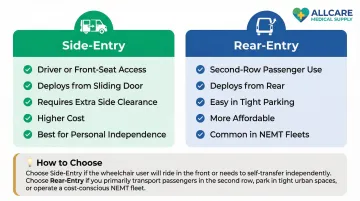
Side-Entry vs. Rear-Entry: Which Configuration Works Best?
Side-Entry Vans
- Ideal for wheelchair users who plan to drive or sit up front
- Ramp deploys from sliding door
- Requires extra side clearance in parking spaces
- Typically more expensive due to complex structural modifications
- Best for personal use and front-seat independence
Rear-Entry Vans
- Better for passengers who stay in their wheelchair in the second row
- More affordable than side-entry conversions
- Easier to park in tight spaces (no side clearance needed)
- Commonly used for commercial NEMT and paratransit fleets
- Offers throughput efficiency and lower ramp slope
How to Choose
If the wheelchair user is the driver or wants front-seat access, side-entry is the right choice. For caregiver-driven transport where budget is a factor, rear-entry delivers strong value without sacrificing safety or functionality.
How We Selected These Vehicles
These vehicles were chosen based on:
- ADA compliance and Federal Motor Vehicle Safety Standards (FMVSS)
- Availability of reputable conversion options (BraunAbility, Driverge)
- Safety ratings from NHTSA
- Suitability for both personal and commercial medical transport use
- Real-world feedback from mobility professionals and users
- Cost range, fuel economy, and interior configuration flexibility
Before you buy, watch out for:
- Focusing only on base vehicle price without factoring in conversion costs
- Overlooking the importance of certified conversion manufacturers and NMEDA QAP dealers
- Not testing ramp deployment, interior clearance, and securement systems before purchase
These same criteria guide fleet decisions for NEMT providers operating in Florida. AllCare Medical Transport, for instance, evaluates every vehicle against ADA and Florida state licensing standards, safe wheelchair and stretcher securement requirements, and the durability demands of daily commercial use.
Conclusion
The right wheelchair-accessible vehicle depends on your use case. Minivans like the Chrysler Pacifica and Toyota Sienna Hybrid lead for personal and family use. Full-size vans like the Ford Transit and Ram ProMaster are built for professional and high-volume transport. The Chevrolet Traverse offers a versatile SUV alternative.
Owning a WAV carries real financial weight. Purchase prices typically run $60,000 to $130,000+, and that's before factoring in:
- Ongoing maintenance and repairs
- Commercial insurance premiums
- Fuel and operational costs
For seniors, hospice patients, and anyone needing occasional medical transport, professional NEMT services often make more practical sense than vehicle ownership.
AllCare Medical Transport is a fully licensed, PASS-certified wheelchair transportation provider serving Palm Coast, Flagler County, St. Augustine, Daytona, and surrounding Florida areas. Available 24/7, AllCare has 16 years of experience treating every client's family with respect and compassion. Call 386-864-7145 or visit allcaremedicaltransport.com to request a free quote.
Frequently Asked Questions
What is the best car for a wheelchair passenger?
The Chrysler Pacifica is widely considered the top choice for wheelchair passengers due to its spacious interior, flexible conversion options, and family-friendly design. However, the best vehicle depends on whether the user is driving, their wheelchair type, and their budget.
How much is a medical transport van?
New minivan conversions (Honda, Toyota, Chrysler) typically run $64,000–$90,000, while full-size conversions (RAM ProMaster, Ford Transit) range from $60,000 to $126,000+. Quality used wheelchair vans start around $25,000–$55,000 depending on age and configuration.
Will Medicare pay for a wheelchair van?
Medicare generally does not cover wheelchair-accessible vehicle purchases or modifications like lifts, ramps, or dropped floors. However, Medicare Advantage plans may cover non-emergency medical transportation (NEMT) rides to covered appointments — contact your plan or state Medicaid program to confirm what's included.
What does WAV stand for in transportation?
WAV stands for Wheelchair Accessible Vehicle—a vehicle modified to safely accommodate a wheelchair user and their mobility equipment, including ramps, securement systems, and interior modifications.
What is the difference between a side-entry and rear-entry wheelchair van?
Side-entry vans allow access through the sliding door and are ideal for drivers or front-seat passengers using wheelchairs. Rear-entry vans use a ramp from the back, are better suited for second-row passengers, and tend to be more affordable and easier to park.
When should I use a professional NEMT service instead of a personal wheelchair van?
Professional NEMT services are the better option for individuals who need occasional or medical-appointment-based transport, seniors who cannot drive, or families who don't want the cost and maintenance of owning a WAV. AllCare Medical Transport, for example, provides 24/7 wheelchair transport with PASS-certified staff throughout Florida — no vehicle ownership required.